

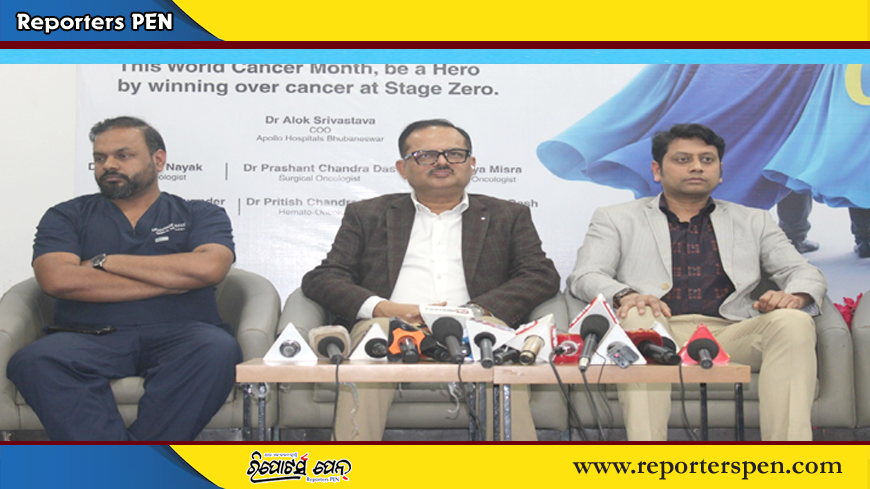
Bhubaneswar, (Reporterspen), : Apollo Cancer Centre has launched its ‘ZERO TO HERO’ campaign in observance of World Cancer Day on February 4, 2026, driving a transformative movement toward detecting cancer at Stage Zero and enabling better survival and recovery.
Cancer cases in India are rising sharply, with over 15 lakh new diagnoses reported in 2024, and numbers continue to increase each year, according to ICMR-NCRP data presented in Parliament. With one in nine Indians now at lifetime risk, cancer has emerged as a pressing public health concern. Yet, over 70% of cases are identified only at late stages (III/IV), when treatment is tougher, outcomes are poorer, and the financial strain on families is significantly higher.
In response to these alarming trends, ACCs’ Zero to Hero campaign spotlights the life-changing impact of Stage Zero detection and early intervention—turning a diagnosis into a story of survival. The initiative celebrates individuals who took timely action and emerged as heroes through awareness, access and prompt care. Though each cancer is unique (brain, breast, neck, lung, pancreas, liver, etc.), but these survivors are united by early diagnosis. Their collective journeys underscore the importance of catching cancer early: it can save lives.
Dr AlokSrivastava,COO& Director of Medical Services,Apollo Hospitals,Bhubaneswarsaid, “Early detection is not just a medical priority—it is a systems priority. The data consistently show that early-stage cancers have markedly higher disease-free survival and longer median survival compared to late-stage diagnoses. At Apollo Cancer Centres, we constantly strive to move beyond treatment to prevention and early detection. Recognising these cases early strengthens our cancer registries, enables faster care pathways, and helps more patients transition from diagnosis to survivorship. This approach has the potential to transform cancer care from reactive to proactive cancer control.”
Dr Prashant Chandra Das,Surgical-Oncologist,Apollo Cancer Centre, Bhubaneswarsaid, “Every day, we see the difference early detection makes. When cancer diagnosed in its earliest stages, treatment is often less invasive, more effective, and survival rates improve significantly. But when diagnosis is delayed, the journey becomes far more complex.
Dr Manindra Nayak, Surgical-Oncologist,Apollo Cancer Centre, Bhubaneswar- Stage Zero cancer means abnormal cells are found early, but they are limited to one place, have not spread anywhere, and can usually be cured completely with simple treatment.
Dr Sandeep Muzumder, Radiation-Oncologist, Apollo Cancer Centre, Bhubaneswar-Zero Stage cancer requires simpler treatment,fewer hospital visits,and shorter recovery-making it far more effortable for patient and families.
Dr Aditya Misra, Medical Oncologist, Apollo Cancer Centre, Bhubaneswar said, “At the heart of the ‘Zero to Hero’ campaign is a simple truth—the real hero is the patient. When individuals prioritise awareness, undergo regular screening, and seek care at the earliest signs, they give themselves the strongest chance to beat cancer. As medical oncologists, we see firsthand than an early intervention can truly change the course of the disease, turning what could be a life-threatening diagnosis into a story of recovery and hope.”
Dr Pritish Chandra Patra, Hemato-Oncologist, Apollo Cancer Centre, Bhubaneswar-Treating cancer at zero stage stops it before it becomes life threatening, preventing metastasis and long-term complication.
One of the cancer hero at Apollo Cancer Centre, proudly said, “When I was diagnosed, the word ‘cancer’ itself was terrifying. But catching it early changed everything for me. My treatment was more manageable, my recovery was faster, and most importantly, I never felt like my life was put on hold. Today, I look back and realise that listening to my body and seeking help early made me a survivor, not a statistic. Initiatives like ‘Zero to Hero’ remind people that cancer doesn’t always have to mean fear or loss; it can mean hope, if you act in time. Early detection gave me the chance to focus on living, not just fighting, and that made all the difference.”
Dr Samarendra Dash, Radiation Oncologist, Apollo Cancer Centre, Bhubaneswarsaid, “Radiation therapy is most effective when cancer is identified early. ModerAt Stage Zero or Stage I, we can often target the tumour with highly focused treatment, reduce the need for extensive surgery or chemotherapy, and achieve better long-term outcomes. Campaigns like Zero to Hero highlight why timely diagnosis is as important as advanced technology in improving survival and quality of life.”